Friday, February 4, 2022

Script Research

The script describes the movement, actions, expressions, and dialogue of the characters in the film. There is a common conception that the script is just the dialog of the actors, but the script is much more. The script is a vital part of the production process and without it, it's an imperative part of the filmmaking process and includes a detailed convention of the script format. First, the screen heading with the INT or EXT, with the INT meaning interior, such as an indoor kitchen or bedroom, and the EXT meaning exterior, meaning outside in a forest or field, you may write INT/EXT or EXT/INT. is the first item production adds next to the shot number. After that is the description of the settings, like a kitchen, classroom, or party, and if it's like night, day, or noon in the setting. The transition to the next shot is at the bottom right. The action of the shot is in the middle of the transition and the setting. The action describes what is occurring in the shot and the type. For example, "Makayla cuts off the crust of her PB & J." would be the action of the shot. Underneath this is the dialog, which entails what the line the actor is supposed to say. This is the basic format of the shot.

This is the script of the 2018 Slender Man, a thriller movie. The script follows the conventions of the script with everything mentioned above. I annotated the script below, highlighting the transition, which is a fade-in in this case. The setting is the park, underlined in blue, and the time of the day, circled in black. The blue brackets are the action of the script. The characters are also circled in black, with the dialogue circled in red. 


This is the script for the opening scene of Jurassic Park. These are two establishing shots that let the audience know the location of the film. I annotated the script to make it clear of the INT and EXT the setting underlined in blue and the action of the film. This script has an extremely detailed action description and capitalizes the names when introducing the new characters.


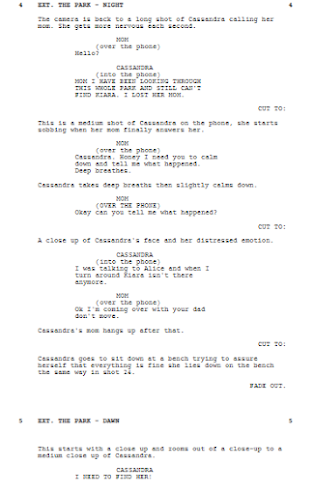
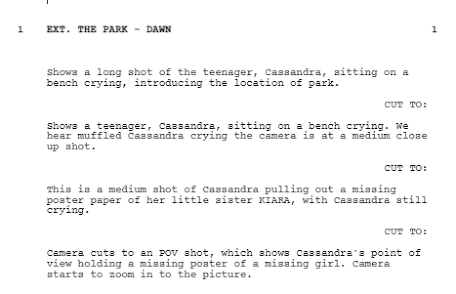
This is my script. I produced it following the conventions of the script. This is for the opening scene of my portfolio project. Our group members spent the majority of the week brainstorming and researching for our script for the opening scene. We amassed a total of 26 shots describing the flashback Cassandra has; we had some trouble fitting the script into the short film, but I think this is a perfect opening scene. When I was writing the script, I would imagine how it would play out in my head and trying to express this to my group members was frustrating, but when I wrote it in the script, they would ascertain my ideas and elaborate on them, getting everyone's input and working as a team.


Reflection

In retrospect, the scripts that my group and I wrote were formatted incorrectly. I accidently formatted the individual shots as scenes in Studio Binder. I quickly updated the script and re-attached it to the blog. Overall, the script could have been more detailed, but we will add it to the storyboard, and I gained a newfound importance for script writing. 

StudioBinder, et al. “How to Format a Screenplay.” StudioBinder, 4 Sept. 2021, https://www.studiobinder.com/blog/brilliant-script-screenplay-format/.



Thursday, February 3, 2022

Case Study

Today we are going to research the movie Mean Girls, released in 2004, directed by Mark Waters and starring Lindsay Lohan, Rachel McAdams, Tim Meadows, Ana Gasteyer, Amy Poehler, and Tina Fey. Let's start with the screenplay of the Means Girls. Tina Fey wrote the screenplay for Mean Girls based on Rosalind Wiseman's 2002 self-help book "Queen Bees & Wannabes: Helping Your Daughter Survive Cliques, Gossip, Boyfriends & Other Realities of Adolescence" with her being inspired to write the characters by her friends and family members. This film was produced by Lorne Michaels Productions, an American multimedia entertainment studio film company that has produced films such as Lassie (1994) and Wayne's World (1992). The intended/target audience for the film is teenage girls, with the primary female cast and the main protagonist of the movie being a woman, and the girly pink aesthetic of the movie. The film's budget cost 17 million, with a box office of 130.1 million USD and a profit of 113 million USD. Mean Girls went under the distribution company that Paramount Pictures was, releasing it in theaters and later having a Broadway show. The marketing of the movie catered to teen girls on online cyberspace and television instead of on newspapers or the radio. The sassiness of the characters stood out when the majority of women were portrayed as soft or delicate. Mean Girls needed Lorne Michaels Productions and Paramount Pictures to work together in order to get them where they are today. 


Witter, Brad. “Tina Fey Used Her Real Life as Inspiration for the Unforgettable Characters in 'Mean Girls'.” Biography.com, A&E Networks Television, 19 May 2020, https://www.biography.com/news/tina-fey-mean-girls-characters#:~:text=When%20Tina%20Fey%20wrote%20the,Boyfriends%20%26%20Other%20Realities%20of%20Adolescence.


Funding, Production and Distribution

Hey, Blog Buddies!

This week in class we are researching the "fun" world of funding, production, distribution, and exhibition. which is a delight for all my classmates, but that begs the question. What is funding? What is production? What is the distribution? What is an exhibition? All of these are critical questions that I will address in my blog post. let us discuss why this is all necessary: funding, production, distribution, and exhibition. These key components all work together as a sequence that starts with funding, production, distribution, and exhibition of the media. First the funding. The funding consists of the film crew garnering money in order to produce the film. Production is used to bring your story together with information such as the casting of actors and, to be more realistic for our opening scene, writing the script. The second stage of producing the film is distribution, releasing and marketing the film to the general population and refining an audience, and the final stage is the exhibition, which entails the screening of the film. 

The Big Six 

Before we start expanding on the topics listed above, we must discuss the six big production companies dominating the film industry: Paramount Pictures, Universal, 20th Century Fox, Warner Bros, and Pictures Walt Disney and Columbia Pictures. These production companies make up over 80% of the film industry, dominating the indie production companies (an indie company is an independent company; the more successful indie companies are known as mini majors). With the large streams of money these six companies hold, they have a huge influence on funding, production, distribution, and exhibition of smaller scale films. Many productions rely on funding from one of the big six companies by pitching the story line and earning a partnership. If I had to decide whether I would be with a large studio or an indie production company, I would select one of the big 6 companies for freedom within the budget because I know I and my group could notafford over ten dollars for our film budget, and with this budget, we have the potential to create a phenomenal film.

Funding 

There are many resources film companies could pull from to fund the film: investors, crowdfunding, or partnering with other companies. Studio Binder recommends crowdfunding for small scale films. Crowdfunding is pitching your story to the internet and users could donate to fund the project. Investing is also another viable option for funding. A person or organization donates money to a film that they feel will produce revenue. Some small film companies choose to partner with one of the big six film companies that fund smaller films, but what do funders receive in return? The investors and companies gain some revenue from the film's production. This is a big incentive for investors, with some of the highest rated films garnering over a hundred thousand dollars in revenue. 

Production 

There are five vital stages of production development: pre-production, production, post-production, and distribution. I will only be addressing development, pre-production, production, and post-production because distribution deserves it on segmentation. Development is the writing of the scripts, story boarding, and funding. Next is the pre-production stage. This is the beginning of the production process, arranging the dates for filming, the location of the setting, and the general preparations before the filming. Now this is the fun part. The production at this stage includes the filming of the movie. The final stage is post-production, which is the editing of the clips and adding background music. The big six production companies are Paramount Pictures, Universal, 20th Century Fox, Warner Bros, and Pictures. Walt Disney and Columbia Pictures also play a role in the production. So, it is important to get to know the companies. Let us start with Paramount Pictures. Paramount Pictures is known for movies such as Titanic, Transformers, and Shrek. It is worth around three billion USD, with the majority of its movies geared toward young children and teenagers. This is shown with most of their popularity coming from movies such as "Shrek" ($267.67M), "How to Train Your Dragon" ($217.58M) and "Forrest Grump" ($330.25M). Universal is a production company worth six billion and directed toward older teens, as shown by some of their top movies being "Jurassic Park," grossing over $654 million, "Furious 7" ($353.01M) and "The Fate and the Furious" ($226.01M). 20th Century Fox is another production company worth over 71 million and has produced popular movies such as "Avatar" ($237M), "X-Men" ($296.3M) and "Deadpool" ($782M) with the theme of sci-fi movies that pander to older teens. Next is Warner Bros, worth $9.3 billion. They produced movies such as "Suicide Squad" ($55M), "The Batman" ($251M) and "Joker" ($1B) with a clear theme of action and thrillers aimed towards young adults and older teens. Perhaps Warner Bros would be ideal to produce my film, with Warner Bros specializing in thrillers similar to the movie me and my group are trying to create. With Warner Bros. partnering with my film, their audience of young adults and older teens would engage with my film and would enjoy "Gone," a thriller, but if I were to partner with Paramount Pictures, with a younger audience, they would not receive this movie well. I would sell my film as a classic kidnapping with an innovative twist of the best friend, Alice, being the kidnapper with no happy ending. Next, Walt Disney is worth $93 billion and has an audience of primarily children, shown with movies such as "Encanto" ($233.9M) or "Zootopia" ($1B). And last but not least, Columbia Pictures, with movies such as "Ghostbusters" ($295.2), "Venom" ($856.1M), and "Spider-Man 3" ($894.9M), caters to an older teen audience with dark action/thriller themes. All these movie companies are successful in making a huge return, as you can see at the box-office in the films above. For example, the budget for "Shrek" was 60 million USD and made a box-office of $267.67 million, which was a huge success for Paramount Pictures. 

Distribution 

The distribution of movies is making them available to an audience. Companies such as Netflix, Hulu, and Amazon Prime are distribution companies that could distribute movies to members who pay a subscription. But the production companies, such as the big sic, do their own distribution. I would distribute my film on Netflix. Netflix is a popular subscription streaming service that has over 221.8 million subscribers. According to PGMag, thrillers have some of the most binge-worthy movies, which makes our film able to thrive on Netflix.


Exhibition 


There are many ways to watch films, such as streaming services, DVDs, or theaters. This is an exhibition! Many film companies choose to premiere their films in theaters in order to generate excitement around the film, whereas others choose to release their films on streaming services such as Disney+ so that you can watch the movie in the comfort of your own home, which, due to the recent pandemic, is the only option for releasing movies. If my movie was to be exhibited, I would select an online streaming service to make it more accessible to my audience.


Hustle, Indie Film. “Understanding the 5 Stages of Indie Film Production - Indie Film Hustle.” Indie Film Hustle®, 13 Dec. 2021, https://indiefilmhustle.com/5-stages-indie-film-production/#:~:text=Film%20Production%20is%20created%20in,different%20roles%20suit%20different%20stages.

Katie. “Film Production: The Seven Stages of Film Production.” IFilmThings, 21 Jan. 2021, https://ifilmthings.com/stages-of-film-production/#:~:text=The%20seven%20stages%20of%20film%20production%20are%20script%20development%2C%20budgeting,%2C%20and%20post%2Dproduction%20stages.].

Moscaritolo, Angela. “Netflix 'Binge Scale' Ranks Most Addictive Shows, Genres.” PCMAG, PCMag, 9 June 2016, https://www.pcmag.com/news/netflix-binge-scale-ranks-most-addictive-shows-genres.

Paramount Pictures, https://www.paramount.com/.

“Ratings, Reviews, and Where to Watch the Best Movies & TV Shows.” IMDb, IMDb.com, https://www.imdb.com/.

Shorr, Arnon, et al. “The 5 Stages of Video Production.” StudioBinder, 26 Jan. 2021, https://www.studiobinder.com/blog/how-to-make-a-movie/.


Tuesday, January 25, 2022

Planning my Portfolio Project


 Hello! Welcome back!

This week we are starting the pre-planning process of our portfolio project. I selected my group members last week, and this is exciting to hear, as I have been looking forward to this project since the beginning of the school year. During the winter break, I have been brainstorming ideas for my portfolio project. I finally landed on that movie idea. A thriller mystery movie dealing with the kidnapping of a young girl (Kiara). Kiara's older stepsister, for the majority of the movie, resents Kiara for bringing her younger stepsister. Kiara and Cassandra went to the park, and Cassandra got distracted with a phone call when Kiara got kidnapped. This inspires Cassandra to go out and find her sister, until she traumatically finds her dead sister. At the end of the movie, Cassandra is seen attending the funeral of Kiara. This parallels the plot of "Taken," in which a CIA agent's daughter is kidnapped in Paris. After I chose the plot for my movie, I needed to find which genre it would fit into. I discussed it with my peers and ultimately decided that it belonged in either a thriller, a mystery, or a thriller-mystery hybrid. I would like to do a mix of both, by using the typical conventions of thrillers and mystery. The convention within my movie is that the older sister (Zariah) is taking her younger sister for granted, which is a common narrative within movies. During the filming, I hope to keep the lighting low-key, but due to my time schedule, I might have to improvise by making the film black and white. The low-key lighting adds a dramatic and mysterious ambiance to the shot and follows the conventions of the thriller genre. During the film, I will try to incorporate high framing into the movie, following another convention of the thriller genre. The popular movie "It" encompasses several of these conventions: the low-key lighting and the high framing. I have been going back and forth with one of my friends to figure out where I should film. She is trying to convince me that we should film in my backyard. So, I did some research to find that most thriller movies are filmed at locations in broad cities, like in the movie "Joker" or the movie "Parasite" that took place in the house. After I concluded my research, I ended up going to the park to film my movie. My movie would incite terror amongst the audience, so it wouldn’t be the best choice for young kids to watch. The intended audience for my movie is older children and teens. I feel like anyone who loves terror and thrills would love this movie. With my captivating plot and the method in which the movie is presented, I would get people to watch my movie. For example, in the movie "Childs Play," the idea that a doll comes alive and starts killing people isn't a new idea, but the way the movie is presented makes it successful. The stereotype in my movie is that the older girl is being rude and the younger girl is more vulnerable, which fits into the typical stereotypes that women play in movies like this one, like the movie "Chick Fight," which plays into the stereotypes that girls are insecure and insolent. For the planning of my portfolio project, I watched five movies: "Parasite", "Bird Box", "Unhinged", "Split" and "The Woman in the Window" to assist me on the journey. All of these movies are thrillers relating to the opening scene me and my group are trying to create. These movies gave me great inspiration for the opening scene. To begin the film "Parasite," the opening sequence starts by panning down and introducing a small boy on the phone. It starts tracking him and leads directly to what he perceives to be his sister. They start talking and eventually have dinner on the floor with minimal furniture. The following shots are of a conversation between the boy and his mother that implements the plot of the movie until the family sits down to eat. This is an "uneventful day in the life" method of opening, with 17 shots introducing all the characters. I presume a "day in the life" scenario would be ideal for the opening scene of my portfolio project, with the kidnapping of the young girl, Kiara, being unusual. Next, Bird Box starts off with an establishing shot of a forest and walkie-talkies playing in the background. It pans to a woman and two children blindfolded in a boat and a man calling out for them to take off their blindfolds; the woman tries to shoot the man but attacks him with a cutlass. "Bird Box" has 64 shots and is a teaser of the rest of the movie, with the killing of the man trying to take off her blindfold being an "Eventful Day in the Life." The next movie, Unhinged, is compiled of 53 shots, a collage of clips of people doing insane activities with the credits displayed throughout. This opening scene doesn’t follow any of the conventions of the opening scene. Split, a 36-shot long opening scene, entails a birthday party and the abduction of a child, creating an inciting incident. The Woman in the Window It is 38 shots long and is about a woman waking up and calling what she presumes to be her kids and husband. She snoops around with her neighbors and has a chat with her therapist about her not leaving the house and her depression. This is a clear example of an uneventful day in her life, with nothing noteworthy occurring throughout the duration of the opening. With all the research I have conducted, this led me to use the "Eventful Day in the Life" to create the opening scene.

Thank you for reading!

Wednesday, December 15, 2021

Holiday Music Video

 Music Video 

During the course of the week, we were assigned to create a holiday themed music video. I gathered together a group of my friends and decided to produce a music video for the popular song "Jingle Bells". We immediately started brain storming ideas, but we had to create a script. In order to create the script, we needed to be decisive on an idea, which was a lot for our indecisive little group. We ultimately decided to make the video of the family, friends, and teachers dance with a Jingle Bells soundtrack over it.

Script Writing

We started the script-writing process by doing research on scripts. We read articles on how to write a script, and we used a studio binder to help us along with this process. The process was fairly simple but monotonous. We messed up the format of the script a couple of times, but we figured it out. The script writing process was beneficial to the story board and got us familiar with the song. For the script, we needed to know if we were filming inside or outside, the setting, what was occurring for the duration of the shot, the transition, and if it was occurring during the day or night. The script provided an insight into the storyboarding process with the number of shots there were and the lyrics of the song. 


The filming process was fairly simple. For the majority of our shots, we needed to film people dancing. We did attempt transitions during the shots, but they didn’t play out correctly in the editing stage. The hardest part of the shoot was getting people to dance. We faced a lot of rejection from our peers, fatigued Publix employees, and teachers. We still got the shots done by taking advantage of our siblings, family, and pets.
Editing 

During class, we had to plan out and draw the shots over the course of two days. Our group could not wait for the story boarding process! We all adored drawing and writing out our ideas. We divided the number of shots equally amongst the group members and filled out the storyboard with information like the shot number, duration, and the action in the shot. The storyboarding stage was cruel for our group; without it, many ideas would be left unclarified and would cause a myriad of issues.

The editing stage is one of best. We got to learn a new editing software, WeVideo. I loved WeVideos' features like the easy-to-use interface but had a hard time seeing past the watermark and low quality. Overall, I wish WeVideo was accessible without the subscription and the editing process was fun. I adore seeing my ideas play out and expressing my creativity.


Wednesday, November 17, 2021

Choosing my Editing Software


The features the editing software needs to have is to be web-based, have the ability to lay multiple tracks (both audio and video), ability to strip or mute audio and natural sounds from video and the ability to collaborate with other users. So I comprised a checklist comparing the editing software. 

Wevideo  

-Accessible from anywhere (web-based)                                    

- Ability to lay multiple tracks (both audio and video)                  

- Ability to strip or mute audio and natural sounds from video    

- Ability to collaborate with other users                                        

-Easy to use                                                                                 

-Free                                                                                             


Videopad 

-Accessible from anywhere (web-based)                                    

- Ability to strip or mute audio and natural sounds from video    

- Ability to collaborate with other users                                        

-Easy to use                                                                                 

-Free                                                                                            


Clip Champ

-Accessible from anywhere (web-based)                                     

- Ability to lay multiple tracks (both audio and video)                  

- Ability to strip or mute audio and natural sounds from video    

- Ability to collaborate with other users                                        

-Easy to use                                                                                

-Free                                                                                            


I made this video in Clip Champ, I silenced clips, added music, dialogue, cut down clips and added transitions. To silence clips I clicked the volume button, to add music I dragged and dropped sound tracks, I did the same with the dialogue. I cut down clips with the scissor tool  found at the top left over the video track, a dragged and dropped transitions in-between the clips to achieve that effect. All of this was fairly easy to use with a clear layout, and tutorials. This was a fun project to do, and I got to know a lot more about my editing software. 

Friday, October 29, 2021

Flim Opening Research

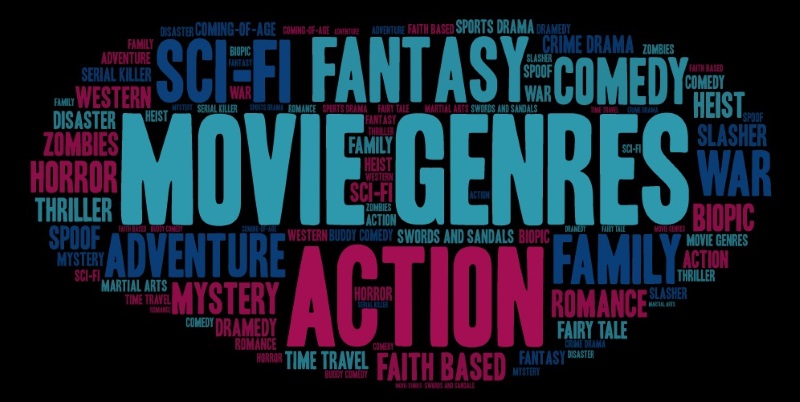
Hey, today on the blog I am going to demonstrate all I know about film openings, like the key elements, the purposes and reasons, and the similarities of opening scenes. I'll also compare horror, thriller, and science fiction, also known as sci-fi.The key elements of the opening scenes are the tone, setting, foreshadowing, and conflict. The tone of the opening scene is critical to setting the mood for the rest of the film. For example, if you watch the opening scene and it's depressing, you wouldn't expect the rest of the film to be cheerful. Setting: The setting of the opening scene is where the story takes place, the plot of the story, and the audience's expectations. Foreshadowing in the opening scene tells a lot about the plot of the movie. It's important to introduce conflict in the opening scene to show the different relationships between the characters. The purpose of film openings is to grab our attention with how they introduce characters and show the genre. How the opening scenes grab our attention is important because, without it, we wouldn't watch the movie. The characters and how they are introduced in the opening scene tells the audience their personality and the role they play in the film. The opening scene reveals the genre of the movie, because the genre has a great influence on the movie. The similarities in the opening scenes are that all opening scenes share a theme and have a message to send. All opening scenes should have a hook leading the audience to an inciting incident.

Horror, thrillers, and science fiction are three very similar yet different genres. The colors of horror are red and black, while thrillers use blue, yellow, and black, and science fiction uses a completely different color palette of red, green, yellow, and blue. Horror often uses sharp violins to build suspense and science fiction uses ambient music, while thrillers often use loud motivating music, which is different to the very subtle music horror and sci-fi use. Overall, characters in thrillers are developed to be smart, unpredictable, charismatic, and brave. Character development is very important in horror to make deaths more meaningful, and science fiction uses character development to fit into the setting and structure. All of these movies' plot structures start in the opening scene. In horror films, women are often represented as victims and men are represented as monsters or heroes, while men are often represented as the main protagonists in thrillers and action movies.

Do you REALLY Know What Genre Your Screenplay Is? - ScreenCraft


There are several different types of film opening that are used across genres: prologue, inciting incident, day in the life, cold opening, and Flash-forward. The prologue gives context to what’s happening through the backstory. There is a type without the voiceover and one with it. The version without the voiceover leaves a ton of exposition to the viewer compared to the version without the voiceover. The version without the voiceover is most likely a flashback, which suggests flashbacks lack tension when done wrong. The inciting incident is a profound change in the protagonist's life that sets the scene for the rest of the movie. A Day in the Life is a type of opening scene that introduces the main character before the hectic events that take place in the film. There are two types of "Day in the Life" openings: exciting and uneventful. The exciting day in their lives displays a dramatic moment in their mundane lives (ex. spy, cop, or bank robber). While the mundane days of life establish the main character, tone, or genre without introducing conflict. Cold open is essentially a teaser for the film, not involving the main characters. Flash forward to when the opening scene takes place in the present timeline of the film, making the film lead up to that point. 


://www.studiobinder.com/blog/best-opening-scenes-in-movies/

https://gizmodo.com/secrets-of-great-characters-according-to-6-science-fic-5065556

https://mythcreants.com/blog/five-essentials-for-an-opening-scene/